by Mike Gaffey
Before Indian River Colony Club — “The Place that Patriots Call Home” — was created in 1986 as a military retirement community, the property was mostly occupied by cows, alligators and accessible only by dirt trails.
In short, the plot of land that is now IRCC was located basically out in the middle of nowhere, according to the book “The Story of Indian River Colony Club 1986-2006.”
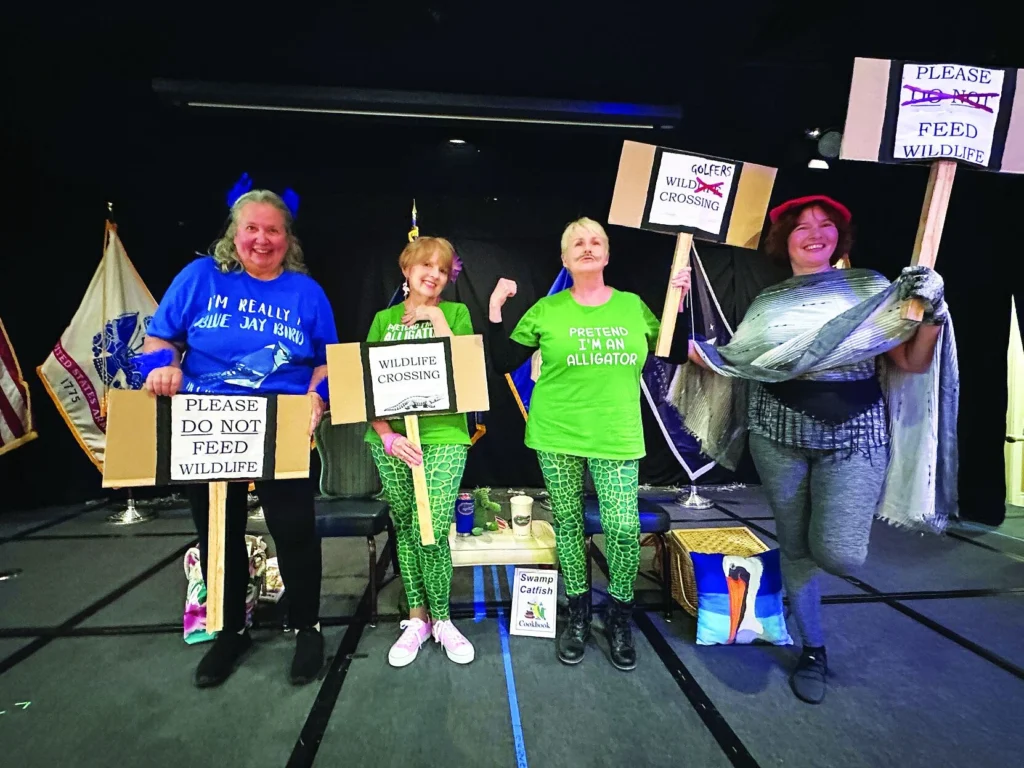
As part of the Founders’ Day celebration, The Cart Barn Players entertained with a humorous skit about the early days of IRCC.
Today, as Viera’s first residential community celebrates its 40th year of incorporation, the 453-acre gated development off Murrell Road has 1,200 residents and 788 single-family homes.
“I think it’s a wonderful place to live whether you’re 100 or 50,” said 99-year-old June O’Connor, one of IRCC’s first residents. O’Connor, who still lives at IRCC with her daughter Barb Jones, turns 100 in October.
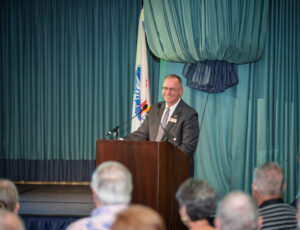
Residents marked the community’s anniversary and Founders Day with events that started on Feb. 18 and wrapped up with a black-tie gala on Feb. 21. The multi-day celebration had “been in the works for over a year,” said Colleen Ward, IRCC’s chairman of the board.
Envisioned in the early 1980s by retired U.S. Air Force Brig. Gen. Charles D. Briggs as a safe, affordable and amenities-filled community for retired military ages 55 and older, IRCC began taking shape in the mid-1980s. Briggs enlisted the help of fellow retired Air Force Gen. Gordon “Bat” Masterson to help make his vision a reality.
In 1986, Briggs reached a deal with Jack Maloy, the vice president of real estate with Oviedo-based A. Duda & Sons, Inc., which owned most of the land between Wickham Road and Barnes Boulevard, to buy 250 acres for $660,000. As part of its initial land sale, Duda, later the parent company for The Viera Company, agreed to provide IRCC with another 57 acres in return for IRCC funding the construction of an extension of Murrell Road.
On Feb. 19, 1986, the nonprofit corporation’s Articles of Incorporation and By-Laws were officially adopted and filed with the State of Florida. By the end of September 1986, more than 100 people had signed up as members, even though no houses had been built or a loan secured.
After Briggs’ death in 1987, Masterson took on the complex task of financing the project and creating the community. “I practically lived in my office for 10 years,” he told Viera Voice in 2016.
After IRCC secured a $3.6 million loan from First Federal of Osceola, home construction started in early 1988. The first residence was completed in June 1988.
Retired Army Chief Warrant Officer Jack Kilz and his wife Dottie became the first residents of IRCC — and later Viera — when they moved into their new home at 1263 Continental Ave.
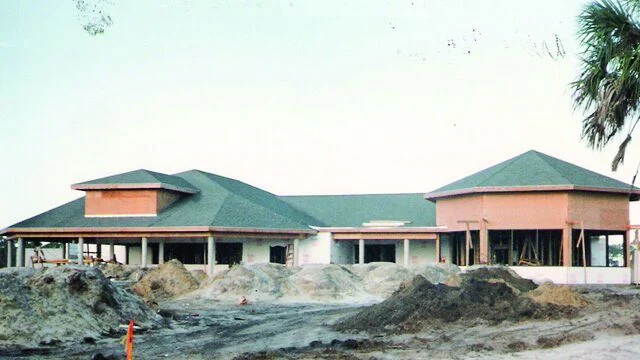
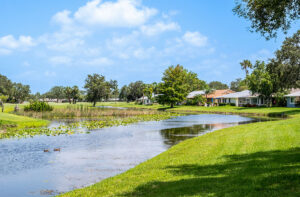
Today, IRCC offers 24-hour gated security and features a private 18-hole, par-72 golf course with putting and chipping greens and an aqua range, a centrally located hub featuring a resort-style clubhouse for casual and fine dining venues and an event and banquet center.
Amenities include a pool, fitness center, a newly renovated court complex housing three tennis courts, a regulation bocce and shuffleboard court and a croquet lawn. Residents also can choose from more than 60 clubs and activities.
The community is owned entirely by its membership and is 100 percent debt free.
“Over its 40-year history, IRCC has never had to impose special assessments, underscoring its stability and sound management,” Ward said.
Originally exclusive to retired military officers, IRCC is now open to a limited number of non-military members.
Scott Miller, the executive vice president, sales, marketing and community development for The Viera Company, said IRCC’s success helped pave the way for Viera’s surging growth.
“IRCC is truly a ‘plank owner’ of the master planned community of Viera, and we could not be prouder to join them in celebrating their 40th anniversary in Viera,” Miller said in a statement.
“The pioneering spirit that built Viera needed bold partners like General ‘Bat’ Masterson, longtime leader of IRCC, to transform the conceptual plans for Viera into the reality of homes, clubhouses and golf courses that gave Viera the essential foundation to become one of the top master-planned communities in the country that we are today.”